Pichvai Paintings: Why a Temple Changes Its Art Eight Times a Day
In the Haveli temple at Nathdwara, home of the child-deity Shrinathji, the Pichvai paintings hung behind the idol are changed up to eight times every single day. Dawn brings one painting. Midday brings another. By nightfall, an eighth is in place. The whole sequence begins again the following morning.
Shrinathji: The Living Deity of Nathdwara
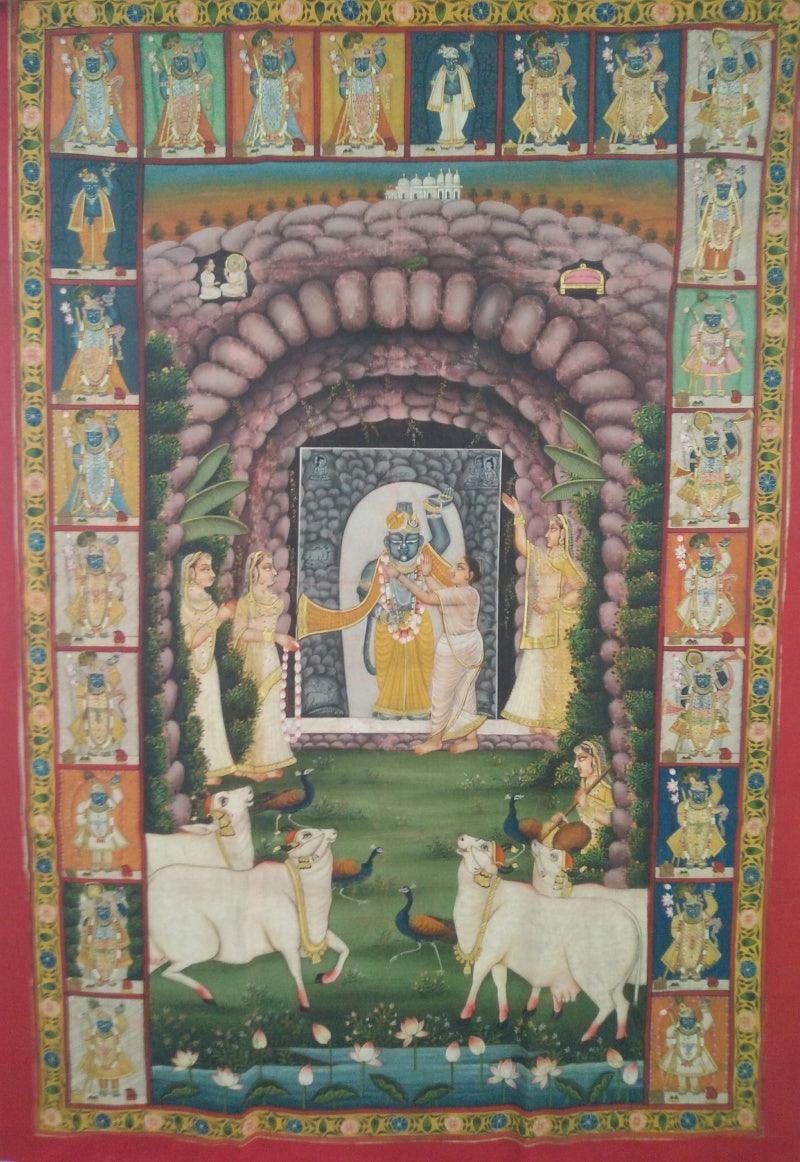
Shrinathji is Krishna in the form of a seven-year-old child, caught in the moment of lifting Govardhan Hill on the little finger of his left hand to shelter the cowherds of Braj from a catastrophic storm. His idol, a black stone relief with his left arm raised and his right hand resting in a fist at his waist, has been housed at Nathdwara since 1672, moved there from Braj to protect it from the iconoclasm of the Mughal emperor Aurangzeb.
The Pushtimarg tradition was founded by the saint Vallabhacharya, and it was his younger son Vitthalnath who institutionalised its elaborate system of worship, developing the selfless seva that defines Pushtimarg devotion to this day, and giving the deity the name Shrinathji (Topsfield 12). The tradition treats the deity as a living child whose daily needs must be met. He is woken up, bathed and dressed. He is also fed several times a day, with food appropriate to the season and the hour. He is then entertained, and finally put to rest. The entire temple operates as a haveli, a traditional mansion or sorts, and the hundreds of people who serve there are like his household staff.
The Eight Darshans of Shrinathji and Their Pichvai Paintings
The eight ritual glimpses of Shrinathji, known as jhānkīs or darshans, each carry their own name, their own mood, and their own painting.
Mangala is the pre-dawn awakening, the most intimate darshan of the day. The deity has just been roused from sleep, and the focus falls entirely on his face. Pichvai paintings for Mangala are uncluttered: pale backgrounds, white lotuses, a sense of morning stillness. The crowd of motifs that will fill later paintings is held back. The goal is quiet, the stillness of 4am.
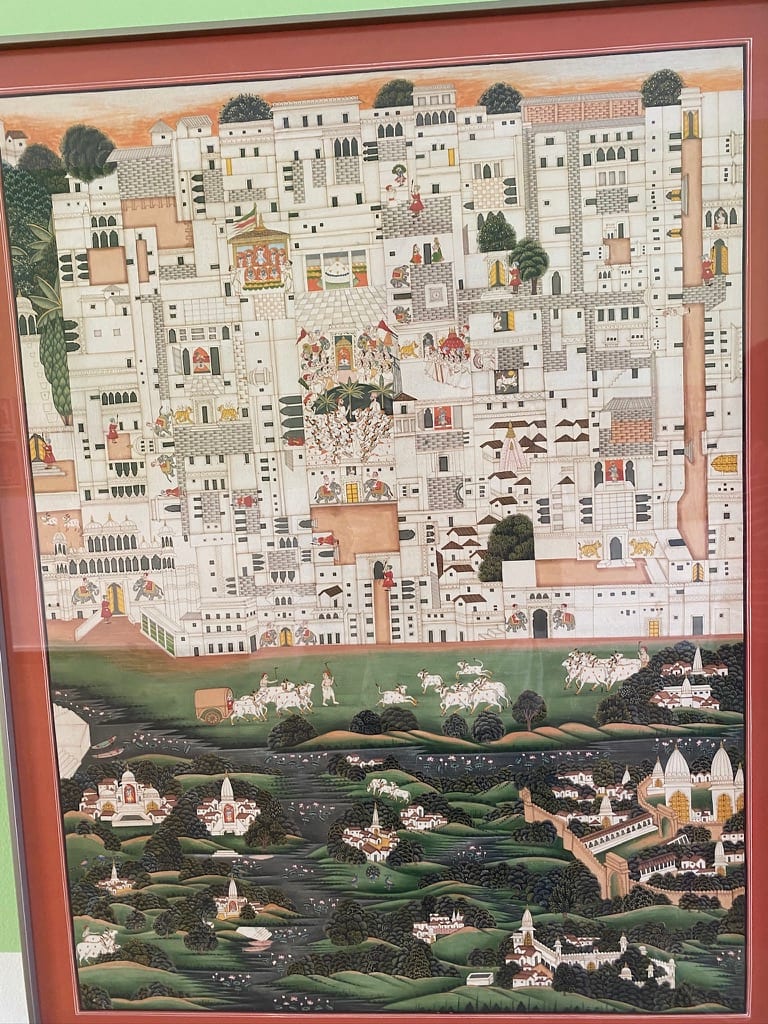
Shringar follows, when Shrinathji is dressed and ornamented for the day. The backdrop changes accordingly. Artists deploy deeper colours, ruby reds and burnished golds, that mirror the jewellery and garments placed on the idol. Temple facades and palace-like architectural frames appear. The painting is, in a real sense, completing the outfit.
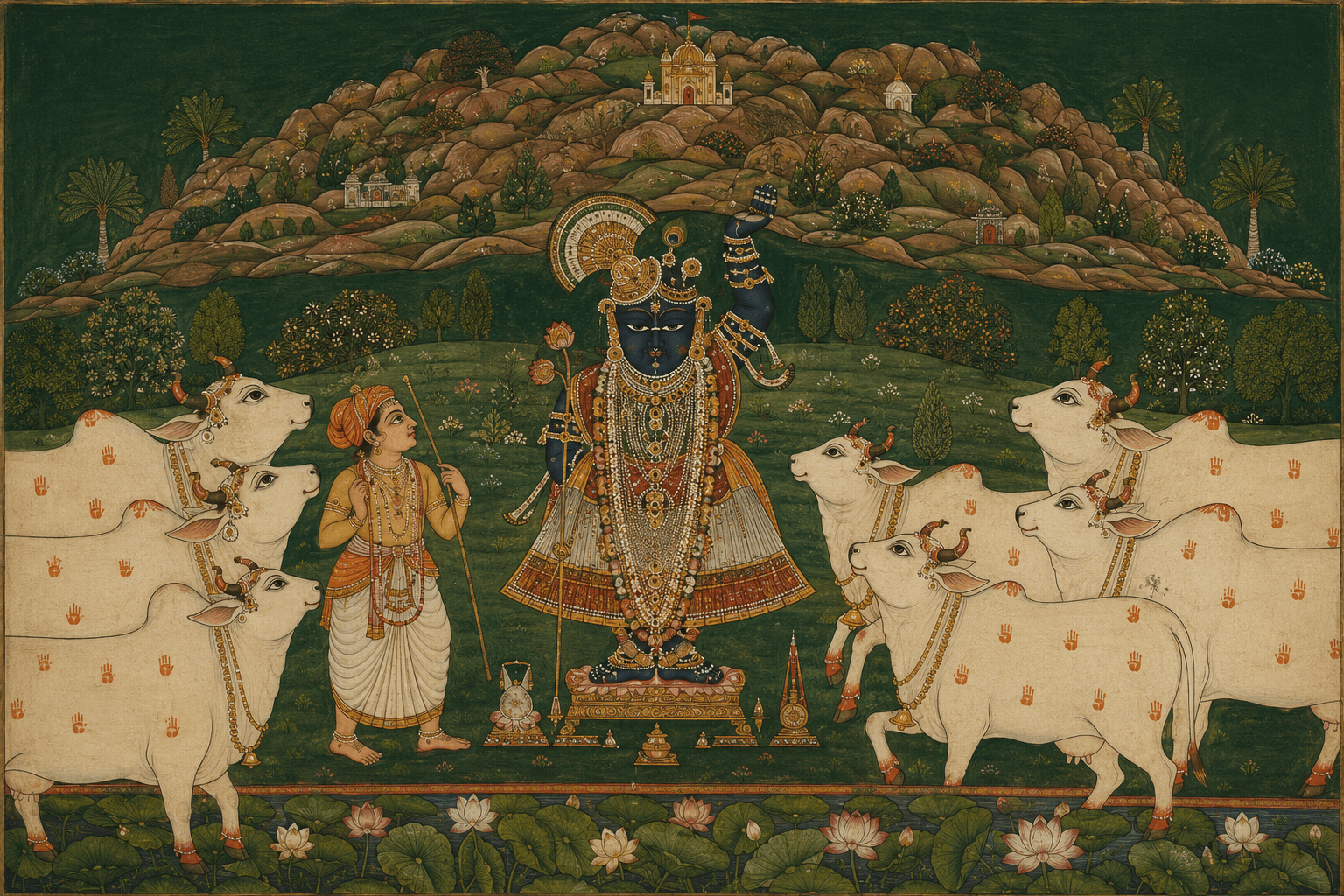
Gwal places Shrinathji as a cowherd heading out into the fields. The palette shifts: greens and earth tones replace the palace opulence, and the compositions fill with white cows whose horns are tipped henna-red, their eyes painted with startling delicacy. Images here have less architecture, and more open land. Unlike other depictions, Pichvais here do not feature the scenes of Krishna and the Gopis as prominently
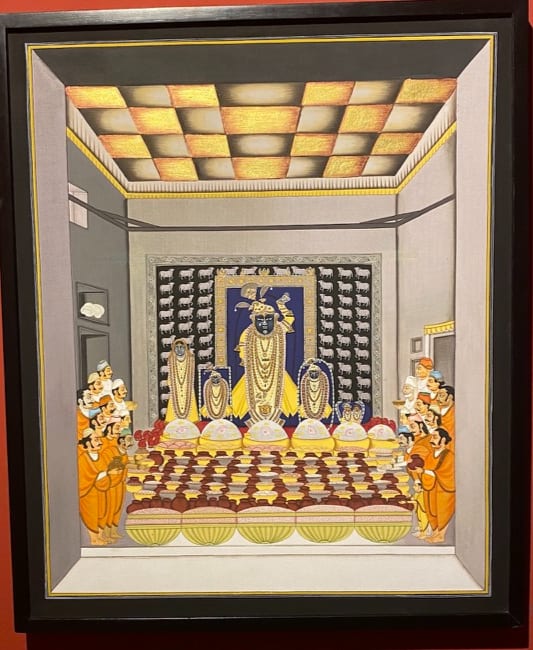
Rajbhog is the midday royal feast. The paintings turn to abundance: piles of food, warm golds and deep greens, often the sheltering mass of Govardhan Hill in the background.
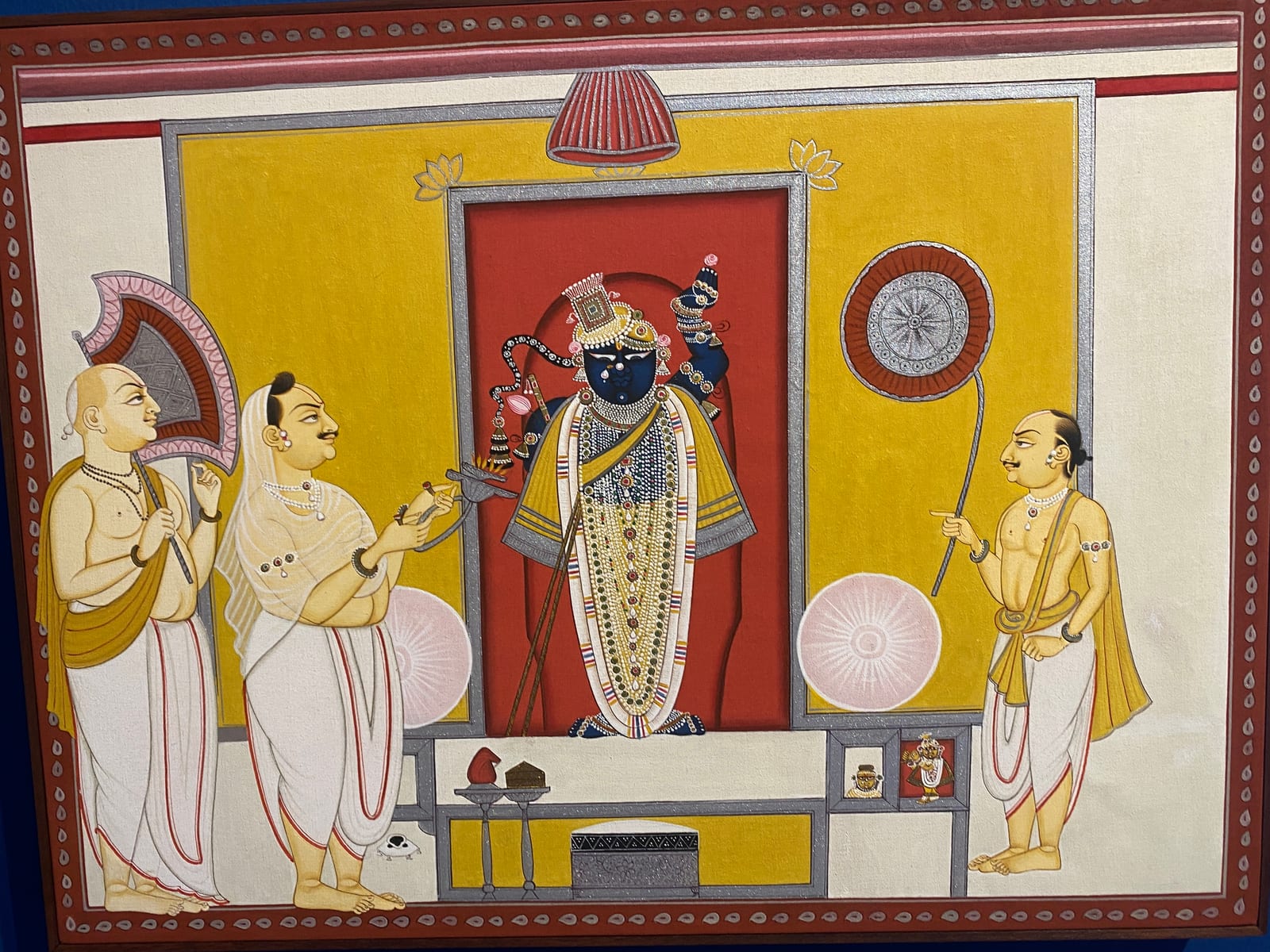
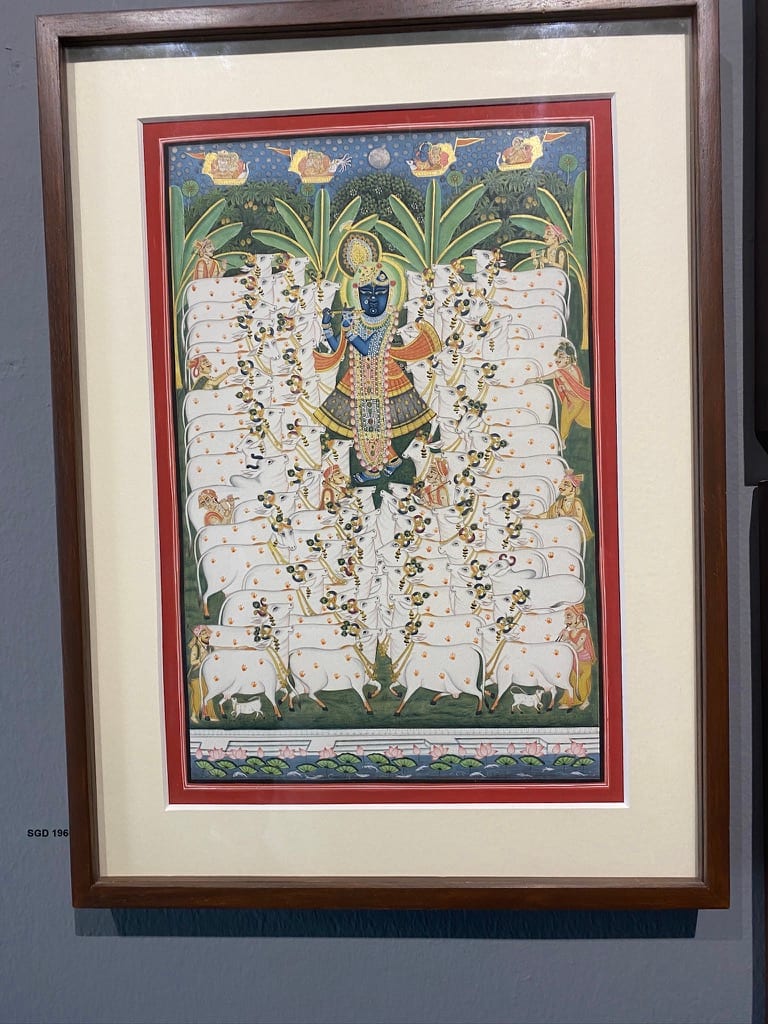
Then come the afternoon and evening darshans: Utthapan, when the deity wakes from his siesta; Bhog, the evening meal; Sandhya Aarti, when lamps are lit and offered; and finally Shayan, when Shrinathji is put to sleep. The paintings in these later hours soften. Warm evening hues give way to darker grounds and flickering lamp motifs, and by Shayan the backdrop has turned nocturnal, often star-scattered or moonlit (Ambalal 34–38).
The sequence is thorough. The consistency and commitment to the changing ritual reflects the commitment that is key to Bhakti. The way this ritual is time-bound and built into daily routine is an example of how worship of God is meant to be built into daily life in bhakti, and God is to be treated as a part of the personal routine.
Pichwai as Ritual Technology: The Role of the Painting in Darshan
Pichvai paintings are what art historians call ritual technology — instruments of a specific practice designed to shape how the people standing before them feel. The devotee comes for darshan, a charged exchange of gaze between themselves and the deity. The painting behind the idol frames that encounter. It tells you what time it is in Shrinathji’s day, what mood he is in, what kind of presence you are entering (Eck 3–6).
These are large cloth paintings, sometimes spanning an entire wall behind the idol, executed in mineral and vegetable pigments on starched cotton, often embellished with gold leaf. Light enough to be hung and removed in minutes.
How Seasons Change the Pichwai: The Annual and Daily Cycles
The daily cycle does not run in isolation. It intersects with the annual cycle of seasons and festivals, so that a Mangala Pichvai in the monsoon month of Shravan, when Rajasthan is drenched and the air heavy with rain, differs markedly from a Mangala Pichvai in January’s dry chill. Both serve the same ritual slot, the same hour of the day. The painting that fills it changes with the season.
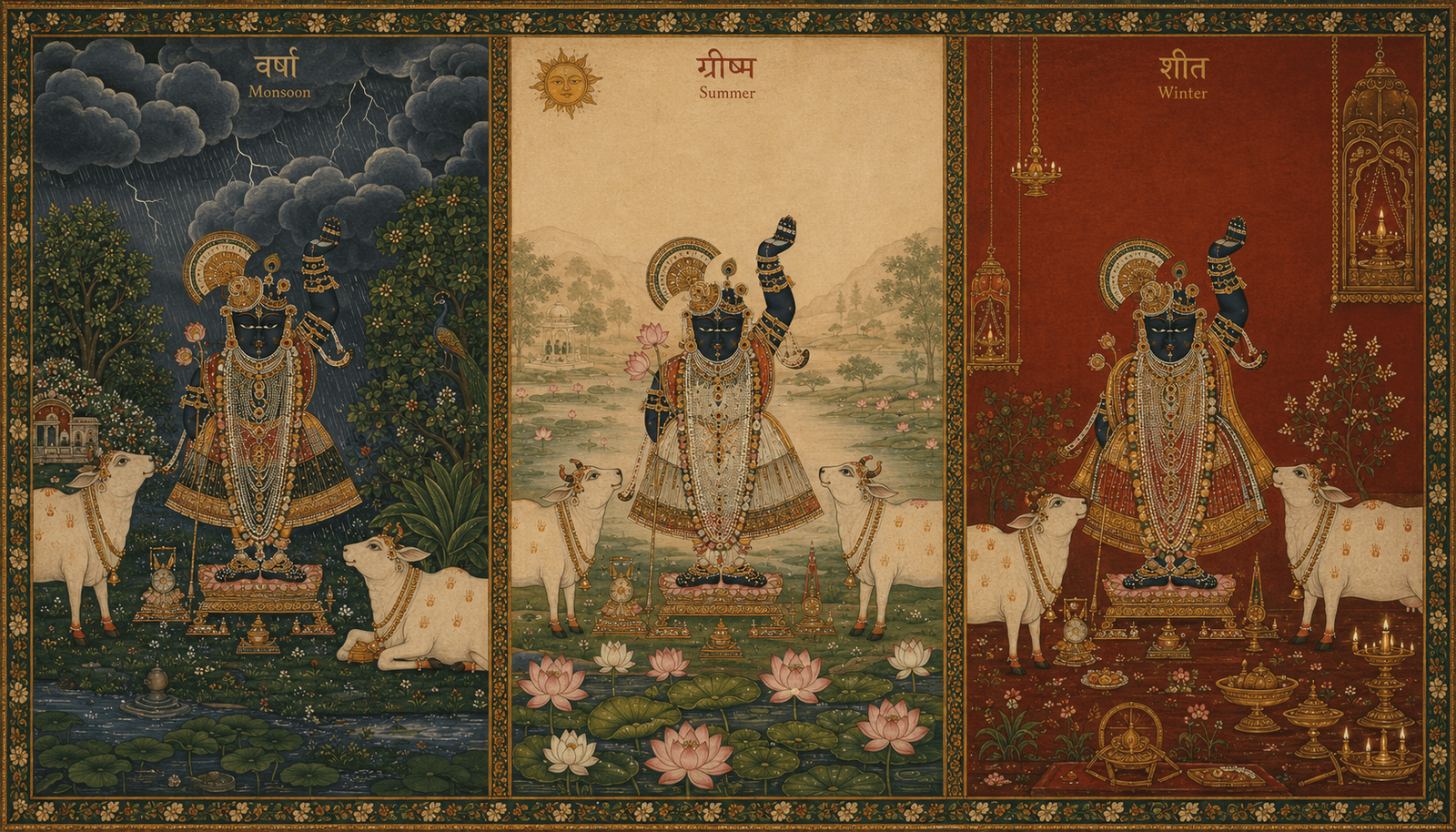
The tradition holds that Shrinathji must be sheltered from the climate too. In the fierce Rajasthani summer, cooling lotus ponds and pale palettes create a visual sense of relief. In the monsoon, dense dark clouds and lush greenery hang behind the deity. In winter, richer reds and golds generate warmth (Topsfield 45).
Seva and the Visual: Why Changing the Painting Is an Act of Worship
Changing a painting eight times a day means worshippers are always watching: the time, the deity, the season, and responding. The ritual builds consistency and commitment, integral to the practice of bhakti, and considered practical steps towards developing attachment to God.
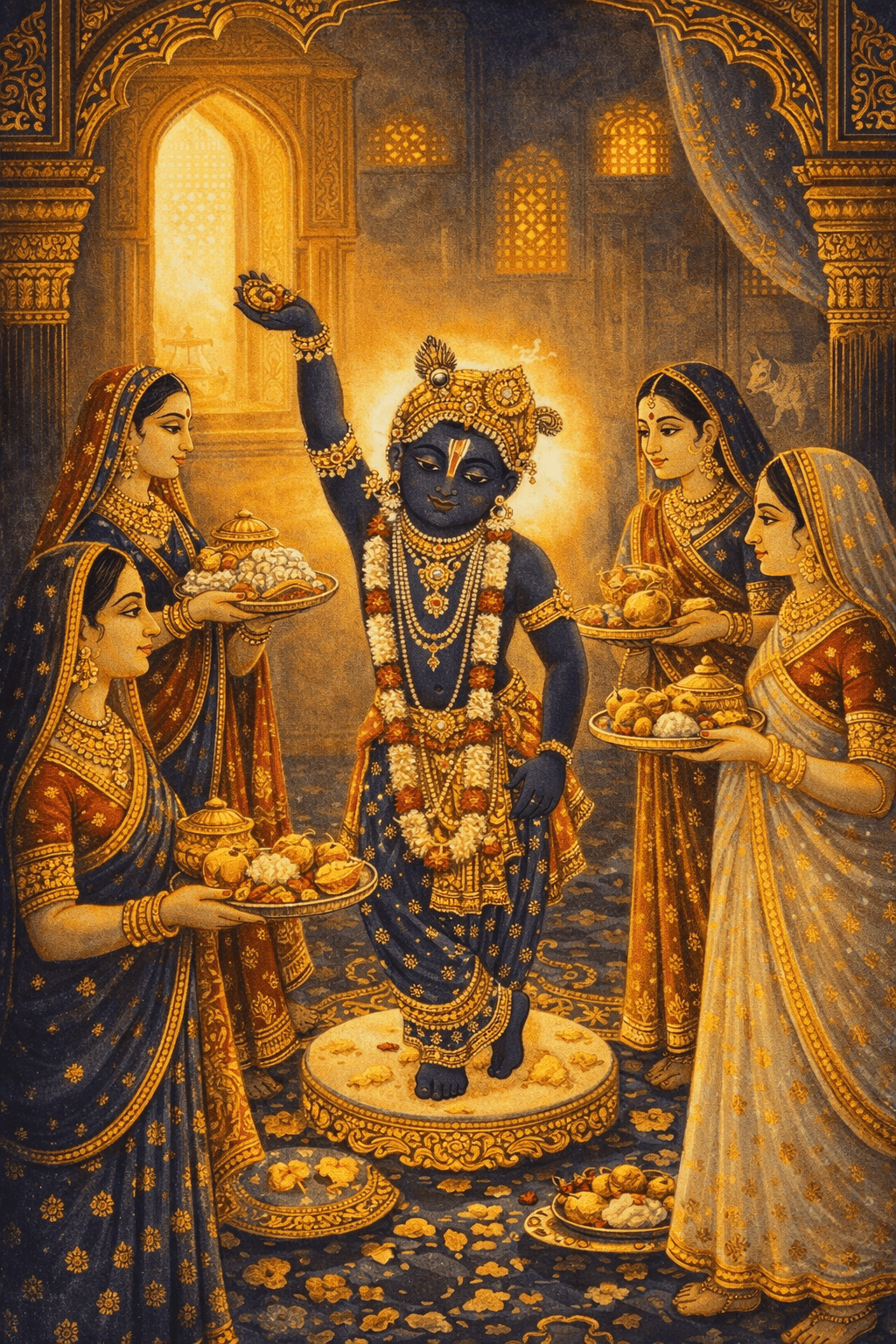
More importantly, the meticulous process also guides worshippers to understand God as a living entity who eats, sleeps and celebrates, not just a painting. This is crucial for a worshipper to form a relationship with the Lord, which is core to Bhakti.
There is a word for Shrinathji’s daily routine of care: seva. Devotional service. The loving attention given to a deity as to a living being. What is striking about Pichvai is that it extends seva to the visual environment. The ritual of changing the painting repeatedly draws attention away from the art and the artist, and the practice itself becomes the art.
Works Cited
Ambalal, Amit. Krishna as Shrinathji: Rajasthani Paintings from Nathdwara. Mapin Publishing, 1987.
Eck, Diana L. Darsan: Seeing the Divine Image in India. 3rd ed., Columbia University Press, 1998.
Topsfield, Andrew. Court Painting at Udaipur: Art Under the Patronage of the Maharanas of Mewar. Artibus Asiae Publishers, 2001.